The HELOC vs credit card interest gap, 2020–2026
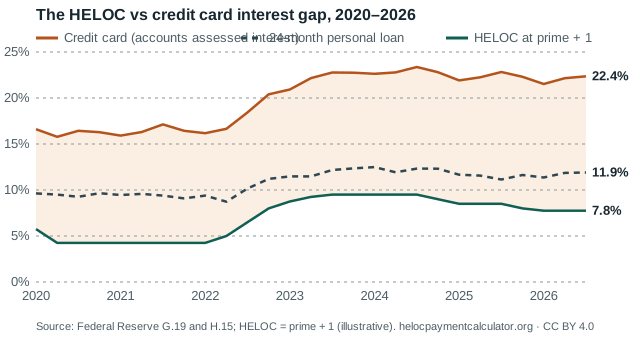
The gap between credit card and HELOC rates is 14.61 points in the latest data, the widest of any quarter since 2020. Credit card accounts assessed interest paid an average 22.36% at commercial banks in Q3 2026, and 24-month personal loans 11.90%.[1] Prime was 6.75% that month, so a HELOC at prime + 1 cost 7.75%.[3] The chart shows every quarter from 2020; the shaded band is the gap between the card rate and the HELOC rate.[2]
- Credit card, accounts assessed interest 22.36%
- 24-month personal loan 11.90%
- HELOC at prime + 1 7.75%
Key findings
- Repaying $10,000 over 5 years at Q3 2026 rates costs $6,694 in interest on a credit card and $2,094 on a HELOC at prime + 1, 3.2 times less.
- The card-to-HELOC gap reached 14.61 points in Q3 2026, the widest since 2020; the narrowest was 10.86 points in Q1 2020.
- From Q1 2022 to Q3 2026, prime rose 3.50 points while the average card rate on balances charged interest rose 6.19 points, from 16.170% to 22.36%.
- The card rate peaked at 23.37% in Q3 2024; Q3 2026's 22.36% is 1.01 points below that peak, while prime is 1.75 points lower.
What $5,000 to $50,000 of card debt costs at today's rates
At Q3 2026 rates, moving a balance from a card to a HELOC cuts the interest by 69%, whatever the amount. The table repays each balance in 60 equal monthly payments at a fixed rate, so it compares the rates alone; a real HELOC rate moves with prime, and card minimum payments would stretch the card balance over far more than 5 years.
| Balance | Card 22.36%: payment | Card: interest | Personal loan 11.90%: interest | HELOC 7.75%: payment | HELOC: interest |
|---|---|---|---|---|---|
| $5,000 | $139.12 | $3,347 | $1,658 | $100.78 | $1,047 |
| $10,000 | $278.24 | $6,694 | $3,316 | $201.57 | $2,094 |
| $25,000 | $695.60 | $16,736 | $8,291 | $503.92 | $5,235 |
| $50,000 | $1,391.20 | $33,472 | $16,582 | $1,007.85 | $10,471 |
Check your own line's draw and repayment payments in the HELOC payment calculator, and see what the margin a lender quotes does to the rate on HELOC rates today.
Full table: every quarter, Q1 2020 to Q3 2026 (27 rows)
| Quarter | Prime | HELOC (prime + 1) | Card APR | Personal loan | Gap | Card interest | HELOC interest |
|---|---|---|---|---|---|---|---|
| Q1 2020 | 4.75% | 5.75% | 16.61% | 9.63% | 10.86 | $4,786 | $1,530 |
| Q2 2020 | 3.25% | 4.25% | 15.78% | 9.50% | 11.53 | $4,521 | $1,118 |
| Q3 2020 | 3.25% | 4.25% | 16.43% | 9.26% | 12.18 | $4,728 | $1,118 |
| Q4 2020 | 3.25% | 4.25% | 16.280% | 9.65% | 12.03 | $4,680 | $1,118 |
| Q1 2021 | 3.25% | 4.25% | 15.91% | 9.46% | 11.66 | $4,562 | $1,118 |
| Q2 2021 | 3.25% | 4.25% | 16.30% | 9.58% | 12.05 | $4,687 | $1,118 |
| Q3 2021 | 3.25% | 4.25% | 17.13% | 9.39% | 12.88 | $4,954 | $1,118 |
| Q4 2021 | 3.25% | 4.25% | 16.44% | 9.09% | 12.19 | $4,731 | $1,118 |
| Q1 2022 | 3.25% | 4.25% | 16.170% | 9.39% | 11.92 | $4,645 | $1,118 |
| Q2 2022 | 4.00% | 5.00% | 16.65% | 8.73% | 11.65 | $4,799 | $1,323 |
| Q3 2022 | 5.50% | 6.50% | 18.43% | 10.16% | 11.93 | $5,377 | $1,740 |
| Q4 2022 | 7.00% | 8.00% | 20.40% | 11.21% | 12.40 | $6,030 | $2,166 |
| Q1 2023 | 7.75% | 8.75% | 20.92% | 11.48% | 12.17 | $6,205 | $2,382 |
| Q2 2023 | 8.25% | 9.25% | 22.16% | 11.48% | 12.91 | $6,626 | $2,528 |
| Q3 2023 | 8.50% | 9.50% | 22.77% | 12.17% | 13.27 | $6,835 | $2,601 |
| Q4 2023 | 8.50% | 9.50% | 22.75% | 12.35% | 13.25 | $6,828 | $2,601 |
| Q1 2024 | 8.50% | 9.50% | 22.63% | 12.49% | 13.13 | $6,787 | $2,601 |
| Q2 2024 | 8.50% | 9.50% | 22.78% | 11.92% | 13.28 | $6,839 | $2,601 |
| Q3 2024 | 8.50% | 9.50% | 23.37% | 12.33% | 13.87 | $7,042 | $2,601 |
| Q4 2024 | 8.00% | 9.00% | 22.80% | 12.32% | 13.80 | $6,845 | $2,455 |
| Q1 2025 | 7.50% | 8.50% | 21.91% | 11.66% | 13.41 | $6,541 | $2,310 |
| Q2 2025 | 7.50% | 8.50% | 22.25% | 11.57% | 13.75 | $6,657 | $2,310 |
| Q3 2025 | 7.50% | 8.50% | 22.83% | 11.14% | 14.33 | $6,856 | $2,310 |
| Q4 2025 | 7.00% | 8.00% | 22.30% | 11.63% | 14.30 | $6,674 | $2,166 |
| Q1 2026 | 6.75% | 7.75% | 21.52% | 11.36% | 13.77 | $6,408 | $2,094 |
| Q2 2026 | 6.75% | 7.75% | 22.15% | 11.86% | 14.40 | $6,623 | $2,094 |
| Q3 2026 | 6.75% | 7.75% | 22.36% | 11.90% | 14.61 | $6,694 | $2,094 |
Download every column, including the all-accounts card rate and the personal loan interest, as the HELOC vs credit card interest gap CSV (27 rows, data checked 2026-11-21). The data and the chart are free to reuse with a link under CC BY 4.0.
Embed this chart
Paste this HTML to show the chart with its source line; the image is a standalone SVG file:
<a href="https://helocpaymentcalculator.org/heloc-vs-credit-card/"><img src="https://helocpaymentcalculator.org/data/heloc-vs-credit-card-interest-gap-2020-2026.svg" width="640" height="340" alt="The HELOC vs credit card interest gap, 2020–2026: credit card, personal loan and HELOC rates by quarter"></a><br>Source: <a href="https://helocpaymentcalculator.org/heloc-vs-credit-card/">HELOC Payment Calculator</a> (CC BY 4.0), data from the Federal Reserve G.19 and H.15.How to cite this data
How to cite: HELOC Payment Calculator. "The HELOC vs credit card interest gap, 2020–2026." https://helocpaymentcalculator.org/heloc-vs-credit-card/. Data: Federal Reserve G.19 (release of November 6, 2026) and H.15 prime rate; HELOC = prime + 1. Updated 2026-11-21. Free to reuse with a link (CC BY 4.0).
HELOC Payment Calculator. "The HELOC vs credit card interest gap, 2020–2026." https://helocpaymentcalculator.org/heloc-vs-credit-card/. Data: Federal Reserve G.19 (release of November 6, 2026) and H.15 prime rate; HELOC = prime + 1. Updated 2026-11-21.How these figures are calculated
Card and personal loan rates are the Federal Reserve's G.19 terms of credit at commercial banks, not seasonally adjusted. The main card rate covers accounts assessed interest: total finance charges divided by the balances they were charged on, which is what people who carry a balance pay. The all-accounts rate, the average stated APR, is in the CSV. Prime is the H.15 bank prime rate on the 7th of each quarter's middle month, the week G.19 surveys. No official series tracks average HELOC rates, so the HELOC column is prime + 1. Interest assumes 60 equal monthly payments at a fixed rate, without fees.
Is a HELOC good for debt consolidation?
A HELOC can be good for debt consolidation when the payment fits your budget, because it cuts the rate on card debt by about 14.61 points; but it turns unsecured debt into debt secured by your home, at a variable rate. Using a HELOC to pay off credit cards works only if those cards are not run up again. The CFPB warns that if you cannot repay a HELOC you could lose the house,[4] while an unpaid card does not put the home at risk in the same way. Weigh the lower rate against these points:
- Costs to open. A HELOC can carry an appraisal fee, an application fee, points and closing costs, plus annual or per-draw fees, and its APR does not include them.[5] On a small balance those fees can eat much of the interest saved.
- A variable rate. The HELOC rate moves with prime: it was 5.75% in Q1 2020 and 9.50% in Q3 2024. Card rates move too, but from a much higher base.
- The line can shrink. A lender may freeze or reduce the line if your home's value falls significantly or your finances change materially.[6]
- No tax deduction. HELOC interest is deductible only when the money buys, builds or substantially improves the home; paying off cards does not qualify.[7] See is HELOC interest tax deductible.
- The cards stay open. The savings disappear if the cards fill up again while the HELOC is being repaid.
The trade-offs of a home equity line in general are on HELOC pros and cons, and a fixed-rate alternative is compared on home equity loan vs HELOC.
Your home is the collateralA lower rate is worth it only if the payment fits your budget through the whole draw and repayment period. Before you borrow, run the payment at a higher rate in the HELOC calculator's stress test.
Frequently asked questions
Is a HELOC cheaper than a credit card?
Usually, by a wide margin. In Q3 2026 card accounts assessed interest averaged 22.36%[1] against 7.75% for a HELOC at prime + 1. On $10,000 repaid over 5 years that is $6,694 of interest versus $2,094, before HELOC fees.
Should I use a HELOC to pay off credit card debt?
It can save a lot of interest, but the debt becomes secured by your home, the rate is variable and opening the line has costs.[5] It works best when the payment fits your budget and the cards are not run up again.
What is the average credit card interest rate right now?
The Federal Reserve's G.19 of November 6, 2026 puts it at 22.36% for accounts assessed interest and 21.19% across all accounts at commercial banks in Q3 2026.[1]
Sources
- Consumer Credit – G.19, September 2026 (Terms of Credit: commercial bank interest rates, not seasonally adjusted)
- Consumer Credit – G.19, historical data: Terms of credit (credit card plans, personal loans), 1972–2026
- Bank Prime Loan Rate (DPRIME), full daily history, CSV
- What You Should Know About Home Equity Lines of Credit (HELOC)
- What you should know about home equity lines of credit (booklet)
- Regulation Z § 1026.40, Requirements for home equity plans
- Publication 936 (2025), Home Mortgage Interest Deduction